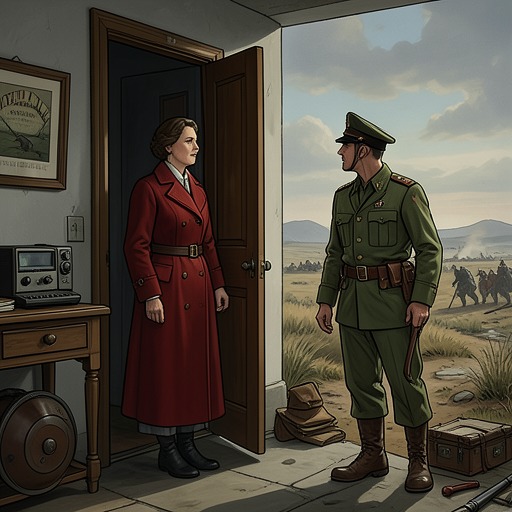
Marie-Laure hides from von Rumpel
All the Light We Cannot SeeMarie-Laure LeBlanc hides from Reinhold von Rumpel by retreating through the house into a concealed space behind a wardrobe. The episode makes survival depend on precise, embodied knowledge: she recognizes a pursuer by the rhythm of his walk, knows where a hidden panel opens, and later measures her way through the rooms by paces and ladder rungs. The ordinary interior becomes both a refuge and a route she must negotiate without being seen.
The Approach and Recognition
A presence at the entrance reaches Marie-Laure first as sound. She concentrates on the entryway three flights below and hears the outer gate close, followed by the front door. The sequence gives her warning but not certainty about who has arrived. Her response begins before she can see or identify the visitor: she attends to the house as a chain of thresholds and listens for what happens next.
When the man starts up the stairs, Marie-Laure recognizes him not by appearance but by his irregular cadence. His step follows a pause and then two beats, a rhythm she has heard before in the walk of a German sergeant major. That recognition identifies the danger for her and the reader without requiring a face-to-face encounter. The approach remains a threat precisely because she is tracking it from elsewhere in the house, through sound and remembered experience.
The Hidden Route
Marie-Laure goes to the large wardrobe at the far end of Henri LeBlanc’s room. She opens its mirrored doors, parts the old shirts inside, and locates the false panel that Etienne LeBlanc has built into its back. Beyond it is a narrow space beside the ladder leading to the attic. She squeezes inside, reaches back through the wardrobe, and closes the doors. Her concealment depends on a feature of the house designed to hide a passage: the wardrobe’s familiar exterior masks a second, private route.
The account later returns to the attic under the section title In the Attic. When Marie-Laure moves again, she has a concrete measure of the route: from the front of the wardrobe, across Henri LeBlanc’s room and the landing, to her doorway is about twenty-one paces. She takes a knife and an empty can from the floor and puts them in her pocket before descending the ladder’s seven rungs. She then remains still against the wardrobe’s back, listening for a long time. The scene’s small, exact measurements convey how movement through the house has become a problem of distance, sound, and exposure.
Concealment and Perception
The sequence gives Marie-Laure no view of the approaching man during her initial recognition. Instead, bodily attention supplies what sight cannot: the gate and door announce an arrival, the cadence on the stairs distinguishes a familiar pursuer, and later listening determines when she can move. Her blindness is not presented here as a general explanation for every action; the passage specifically shows how she uses hearing and a learned map of the house to respond to immediate danger.
The house’s layout is not merely background. The wardrobe, false panel, ladder, landing, and rooms form a navigable structure whose distances Marie-Laure knows. She has to pass through that structure without drawing attention, and she uses its concealed architecture to interrupt the pursuer’s access to her. Her knowledge is practical rather than abstract: she knows where the panel is, how many rungs the ladder has, and approximately how many paces separate one doorway from another.
The little wooden house against her ribs extends the scene’s concern with hidden interiors. While crouched behind the wardrobe, Marie-Laure wonders whether a tiny likeness of herself inside its miniature attic is also waiting and thirsty. The thought links her actual hiding place to the model without changing the immediate facts of the escape. Both spaces contain an interior concealed within another interior, and the miniature makes her position in the house feel newly visible to her imagination even while she remains physically hidden.
The Wider Occupied Setting
The surrounding evidence places the episode within the occupation of Saint-Malo, where household life is shaped by surveillance, restrictions, and acts of resistance. An order requires residents to surrender radio receivers at 27 rue de Chartres and threatens arrest for anyone who disobeys. Elsewhere, Madame Ruelle drives at dusk with companions to rearrange road signs before returning to Number 4 rue Vauborel. These details establish a world in which movement and communication can carry risk, though they are not presented as the direct cause of Marie-Laure’s hiding in this scene.
Letters elsewhere in the narrative register the same pressure at a domestic scale. Frau Elena writes to a professor after months without hearing his broadcasts and describes how a powerful transmitter in Brandenburg overwhelms other stations. Jutta’s letter to Werner describes cold, shortages, and laundry work; Werner’s letter to Jutta is heavily marked by censorship and includes his thoughts about predetermination. These separate documents widen the episode’s context: private homes and correspondence exist within a system that controls information and narrows ordinary choices. They do not explain Marie-Laure’s immediate route through the wardrobe, but they make the contrast legible between public power and the intimate, local knowledge by which people endure it.
The Return Through the House
Later, Marie-Laure reaches the landing and the threshold of her grandfather’s bedroom. She feels her way to the wardrobe, climbs through its open doors, and gently closes them behind her. The movement returns her to the same concealed architecture used earlier, but the careful description emphasizes a changed task: she is now navigating back through the house after remaining hidden. The passage gives no broad account of what happens to the pursuer at that moment; its attention stays with Marie-Laure’s measured progress, the remembered route, and the quiet closure of the doors.
The episode’s suspense comes from the difference between the pursuer’s approach and Marie-Laure’s limited but exact knowledge of the interior. He is registered by the rhythm of his steps; she responds with a hidden passage, counted distances, and pauses to listen. The house that might seem a fixed domestic setting becomes a changing map of danger and shelter. Marie-Laure’s escape is not a victory over the occupying force as a whole, but a specific act of evasion grounded in observation, memory, and familiarity with the rooms around her.